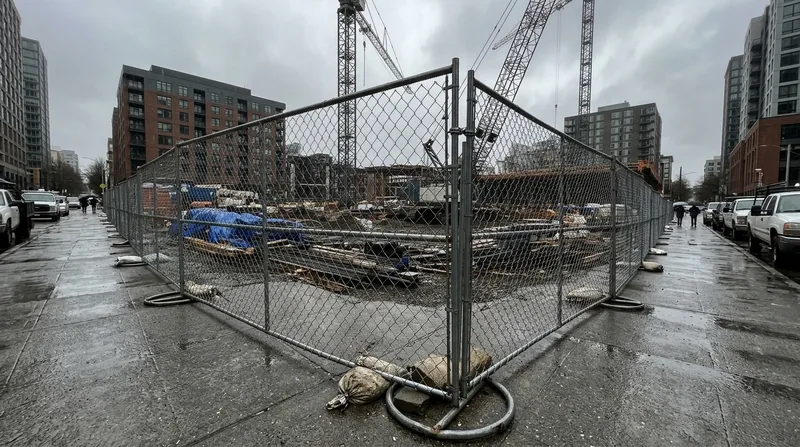




Commercial sites across King County need commercial fence installation in Seattle that holds up through the region's long wet season. Whether you're securing a construction site, staging a temporary event perimeter, or protecting an active work zone, temporary and commercial fencing must anchor firmly against wind and weather while remaining cost-effective and easy to install and remove. Seattle Fence Pros has installed and maintained commercial chain link fence, temporary construction fence, and security barriers for contractors, property managers, and event organizers since 2016. We set up and take down panel systems anchored to handle conditions on Puget Sound, and we work fast so your site stays secure and compliant with local code from day one.
Why Commercial and Temporary Fencing Matters on Seattle Job Sites
A construction site fencing system does more than mark a boundary. It contains dust and debris, keeps pedestrians and equipment out of active work zones, and signals to inspectors and neighbors that the site is managed and secure. In Seattle and surrounding areas, most jurisdictions require temporary fencing on active construction projects, and many require documented removal before final sign-off. Wind, rain, and ground saturation can shift or collapse an improperly anchored panel system within days. A solid temporary fence also reduces liability exposure, protects material stored on-site, and keeps your project on schedule.
- Temporary panel systems anchor quickly and hold against Puget Sound wind exposure without permanent post installation.
- Chain link and welded mesh options contain debris and allow visibility into the work zone for safety inspections.
- We install and remove on your timeline, so you pay only for the fencing period your project actually needs.
- Proper anchoring and bracing prevent weather-related failures that delay project schedules and create liability claims.
A well-installed temporary fence protects your site, your crew, and your timeline.
Key info: Seattle and most King County jurisdictions require temporary construction fence on active sites. Your general contractor or project manager should verify the specific height, material, and setback rules with your local building department before we install. We work from your site plan and local code requirements to ensure compliance from day one.
For more detail on how temporary fencing integrates with broader site security, see our chain link fence installation page, which covers the mesh and gauge options that work best for containment and visibility.
How We Install and Manage Commercial Fencing in Seattle
Our process starts with an on-site walkthrough to assess ground conditions, wind exposure, and access for equipment. We confirm the fence line with you or your project manager, locate any utilities using Washington 811, and then anchor the system using concrete footings, ground anchors, or weighted base plates depending on site conditions and code. Panels are tensioned and braced to prevent sag and movement, and we document the installation so inspectors and your GC have a record of what was installed and when.
- We call Washington 811 before any post hole digging to mark underground utilities and prevent damage and injury.
- Panels are set plumb and braced with anti-sag hardware to stay rigid through wind and weather.
- We use concrete-set posts or ground-anchored systems depending on whether the fence is permanent or temporary.
- We provide a removal date that matches your project schedule, and we haul away all materials when the job is done.
- Silt fence installation is available for erosion control on graded or excavated sites, meeting local stormwater and environmental code.
The result is a secure, code-compliant perimeter that stays in place for the duration of your project.
Example: A commercial renovation in Bellevue required a 6-foot chain link fence around an active site for 14 weeks. We installed 240 linear feet of 6-gauge mesh on concrete footings, added anti-sag bracing every 8 feet, and removed the system once the final inspection passed. The property manager had a documented photo record for their GC and insurance carrier, and the site stayed secure and compliant throughout.
Learn more about the materials and gauge options available by visiting our fence repair page, which covers the durability standards we apply to all installations.
Commercial Fencing Methods and Materials
| Approach | Description | Best for |
|---|---|---|
| Chain Link Panels on Concrete Posts | 6-gauge galvanized or powder-coated mesh on 2-inch diameter posts set 24 to 30 inches deep in concrete, with tension bands and stretcher bar hardware. | Long-term temporary sites, construction projects lasting weeks to months, containment with visibility for safety inspections. |
| Welded Mesh Panels on Ground Anchors | Pre-fabricated welded mesh panels anchored to ground with weighted base plates or auger-type anchors, no digging required. | Short-term events, staged perimeters, sites where digging is not permitted or ground is too hard or saturated. |
| Silt Fence and Erosion Control | Woven or non-woven geotextile fabric stapled to wooden stakes or posts, installed along the perimeter of graded or excavated areas. | Stormwater and sediment control, compliance with environmental permits, protection of adjacent properties during site work. |
| Solid Privacy Panels for Commercial Security | Plywood or vinyl privacy inserts fitted into chain link or aluminum frame systems, blocking line of sight into the work zone. | High-visibility sites, material storage areas, projects where privacy or aesthetics matter to neighbors or the public. |
Each system is anchored and braced to meet local code and to handle wind, weather, and the wear of an active job site. We choose the method based on your site conditions, project duration, and budget.
Commercial and Temporary Fencing Cost in Seattle: What to Expect
The cost of a commercial security fence or temporary construction barrier depends on the material, the linear footage, site access, ground conditions, and how long the fence needs to stay in place. A free site quote is the best starting point. We measure the fence line, assess anchoring requirements, and factor in the complexity of the installation so you get a realistic number before you commit.
Temporary panel systems on ground anchors are typically the most affordable option for short-term projects. Concrete-set posts cost more upfront but provide better long-term stability for sites lasting more than a few weeks. Silt fence is priced per linear foot and is often the most cost-effective way to meet stormwater code on graded sites. Removal and haul-away are included in the quote, so there are no surprise costs when the project ends.
Getting 2 or 3 estimates from local contractors is smart. Compare the material gauge, the anchoring method, the removal timeline, and the insurance and liability coverage each quote includes. The lowest price is not always the best value if the fence fails mid-project or if the contractor disappears when it's time to remove it.
Call us at (425) 696-3219 for a free estimate, or visit our pricing page for typical costs by project type and size.
How to Choose a Commercial Fencing Contractor Near Me in Seattle
Hiring the right contractor for your commercial or temporary fencing project protects your budget, your timeline, and your site. Start by asking for references from recent projects of similar size and scope. Call those references and ask whether the fence held up through weather, whether the contractor showed up on time for removal, and whether there were any surprises in the final bill. Check that the contractor carries general liability and workers compensation insurance and can provide a certificate of insurance on request.
In Washington, fence installation is not subject to a state trade license or registration requirement. However, contractors working on projects above a certain threshold may need to register with the Department of Labor and Industries as a construction contractor. Your general contractor or project manager should verify the threshold and any registration requirements with the local building department before work begins. We are fully insured and can help document any site damage for your insurance carrier.
Ask each contractor about their experience with local code, utility locates, and permit requirements in your specific city or county. Fencing rules vary across King County, and a contractor who knows the rules in Seattle may not know them in Renton or Kirkland. Ask how they handle site conditions like saturated ground, sloped terrain, or limited access. Finally, confirm that removal is included in the quote and that a specific removal date is written into the contract.
Ready to get started? Contact us for a free estimate and a straightforward conversation about your project.
Commercial & Temporary Fencing in Seattle: Pricing Guide
| Service | Price | Details |
|---|---|---|
| Temporary Chain Link Panels (per linear foot) | Starting at $18 | 6-gauge galvanized mesh on ground anchors, installed and removed, includes utility locate and basic anchoring |
| Concrete-Set Chain Link (per linear foot) | Starting at $32 | Posts set 24 to 30 inches deep in concrete, tension bands and stretcher bar hardware, stable for long-term projects |
| Silt Fence Installation (per linear foot) | Starting at $8 | Geotextile fabric stapled to wooden stakes, erosion control and stormwater compliance on graded or excavated sites |
| Privacy Panels or Welded Mesh Inserts | On estimate | Solid or semi-solid panel upgrades, specialty materials, and custom bracing require on-site assessment and material sourcing |
| Removal and Haul-Away | Included | All temporary fencing removal and material disposal included in the installation quote, no separate charge |
| Site Estimate | Free | On-site walk-through, material and method recommendation, written quote within 24 hours, call (425) 696-3219 |
Indicative pricing, the exact cost depends on square footage, finish, and site access. Free personalized estimate within 24h at (425) 696-3219.


