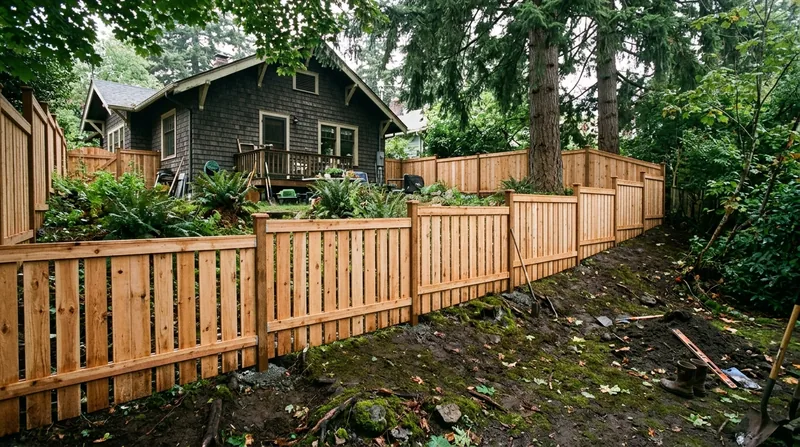




Privacy fence installation in Seattle means working with the region's challenging terrain and moisture patterns. Vashon glacial till, dense clay, and the area's long wet season create real obstacles to standard post-setting methods. We install cedar privacy fences with proper drainage at the base, setting posts in concrete where the ground allows and tamped where it doesn't, because rot at the ground line happens faster than frost heave ever will. A well-built wood fence lasts 15 to 20 years in this climate when the posts are set right and the wood species matches the exposure. This guide covers what you need to know about wood fence installation in Seattle, how the work gets done, and what to budget.
Why Wood Privacy Fencing Matters in Seattle
A privacy fence does more than block the view from the street or a neighbor's yard. It anchors your property line, contains sound and wind exposure, and creates a defined outdoor space that adds real value to a home. In Seattle's residential neighborhoods, privacy fencing is the workhorse boundary solution, and the material and installation method determine whether it holds up or fails early.
- Cedar and pressure-treated pine handle Seattle's moisture better than softwoods that swell and shrink with seasonal changes.
- Board-on-board and side-by-side configurations each offer different aesthetics and wind resistance for sloped or exposed lots.
- Post spacing, concrete depth, and drainage at the base prevent rot and leaning, which are the two most common failure modes in the region.
- Six-foot privacy fences are the standard height for residential screening, though local code and HOA rules may impose limits; always verify with your city or homeowners association before ordering materials.
Choosing the right material and method upfront saves thousands in repairs and replacement down the road.
Key info: Seattle and Bellevue both require fence permits in most residential zones, and setback rules vary. Check your city's Department of Construction and Inspections (SDCI) or your local building department before breaking ground. HOA communities often have height, material, and color restrictions that override city code, so review your deed restrictions first.
How We Install Wood Privacy Fences in Seattle
Our process starts with a site walk, utility locate, and honest assessment of the ground and your goals. We work from your existing survey or the line you identify, and we mark every post location before we dig. The Vashon glacial till in much of the Seattle area is dense and wet, so we use real drainage strategy: posts are set in concrete where the ground permits, and we always backfill with gravel and slope away from the post base to shed water. Board-on-board and racked installations follow the terrain, and every rail and picket is cut and fastened to stay plumb and square.
- We call in a utility locate (Washington 811) before any digging, because hitting a gas or electrical line stops the job and creates liability.
- Posts are set in concrete at least 24 to 30 inches deep, depending on soil conditions and frost depth in your zone; we assess and tell you what the ground requires.
- Cedar posts are selected for grain and straightness, and pressure-treated pine is used where the budget is tighter or where extra rot resistance matters near splash zones.
- Rails are lag-bolted or screwed to posts, not nailed, so the fence moves with seasonal swelling without splitting or loosening.
- Pickets are spaced and fastened with stainless or galvanized hardware to resist rust and staining in wet climates.
The entire job is framed around keeping water away from the post base and building a fence that moves without breaking.
Example: A typical backyard in Kirkland or Redmond with 150 linear feet of 6-foot cedar privacy fence takes 3 to 5 days. If the ground is rocky or the slope is steep, we step or rack the fence to follow the terrain, which adds precision but not dramatic cost. If you need the work done faster, we discuss crew size and schedule upfront. Visit our pricing page for detailed breakdowns by material and job size.
Wood Fence Installation Methods: Comparison Table
| Approach | Description | Best for |
|---|---|---|
| Board-on-Board Cedar | Pickets overlap slightly on both sides, creating a solid appearance with no view through and excellent wind resistance. | Privacy-first residential lots, exposed or windy sites, maximum visual screening. |
| Side-by-Side Pickets | Pickets butt edge-to-edge with no overlap, creating a clean, traditional look with slightly less wind drag. | Standard residential privacy fences, lots where traditional aesthetics matter, moderate budgets. |
| Pressure-Treated Pine | Chemically treated softwood with lower cost and good rot resistance; requires more frequent staining and sealing over time. | Budget-conscious projects, areas with high ground moisture, homeowners willing to maintain stain every 2 to 3 years. |
| Racked or Stepped Installation | Fence follows a slope by racking (angling) or stepping (level sections with posts at different heights) to maintain plumb pickets. | Sloped lots common in Seattle, Bothell, and Sammamish; preserves appearance and drainage on uneven terrain. |
Wood and Privacy Fence Installation Cost in Seattle: What to Expect
Wood privacy fence installation in Seattle starts at around $34 per linear foot for pressure-treated pine with standard 6-foot height and side-by-side pickets on level ground. Cedar and board-on-board configurations run higher, typically $40 to $55 per linear foot, because cedar costs more, board-on-board uses more material, and both demand tighter craftsmanship. A 150-foot run of cedar board-on-board on a sloped lot with dense soil and utility locates could land at $6,000 to $8,250 before permits or any site prep.
The biggest cost drivers are post spacing and depth (determined by soil and frost depth), the wood species and grade, the picket configuration, terrain (racked or stepped installations add labor), and access for equipment. If your lot is tight, wet, or sloped, the job costs more because the work is slower and more precise. Always get 2 to 3 estimates from local installers, because soil conditions, HOA requirements, and local permit rules vary block by block in the Greater Seattle area. A free estimate from us comes with a site walk and honest guidance on what your ground actually requires.
Visit our full pricing page for material-specific rates and examples of common job sizes in Seattle and surrounding areas.
Wood and Privacy Fence Installation Near Me: What Seattle Homeowners Should Know When Hiring
Finding a fence installer near you in Seattle means checking three things: insurance and workers' compensation coverage, how fence work is regulated in Washington, and whether the crew has real experience with the ground and code in your specific neighborhood. In Washington, fence installation does not require a state trade license or contractor registration for jobs below certain thresholds, though some cities and counties impose local permitting. Always verify your city's rules and any HOA architectural standards before you sign a contract. Get references from recent jobs in your area, and ask about their approach to post drainage and material selection, because that's where the difference between a 10-year fence and a 20-year fence lives.
- Confirm that the installer carries general liability and workers' compensation insurance, and ask for a certificate of insurance naming your address.
- Ask about their experience with Vashon glacial till, dense clay, and wet-season drainage, because standard post-setting methods fail in Seattle's soil.
- Request references from jobs completed in your neighborhood or similar terrain within the past 2 to 3 years.
- Understand your city's permit rules by calling your local building department; some jurisdictions require permits for all fences, others only for fences above a certain height or in setback zones.
- If you live in an HOA community, review your architectural standards for height, material, color, and finish before meeting with the installer.
Get your free estimate from us by calling (425) 696-3219, and we'll walk your site, answer your questions, and give you honest guidance on what makes sense for your property.
We're an AFA Member Installer (American Fence Association) and have been serving the Seattle area since 2016. We work across Seattle, Bellevue, Kirkland, Renton, Redmond, Kent, Everett, Tacoma, Bothell, Edmonds, Lynnwood, Shoreline, Issaquah, Sammamish, Burien, Mercer Island, SeaTac, Auburn, Federal Way, and Mukilteo. If you need fence repair, vinyl fence installation, or gate installation and repair, we handle those too. Contact us to schedule your free estimate today.
Wood & Privacy Fence Installation in Seattle: Pricing Guide
| Service | Price | Details |
|---|---|---|
| Pressure-Treated Pine Privacy Fence | Starting at $34/ft | Side-by-side pickets, 6-foot height, standard post spacing; cost rises with slope, dense soil, or racked installation |
| Cedar Privacy Fence | Starting at $40/ft | Board-on-board or side-by-side, superior rot resistance, natural appearance; higher material cost and craftsmanship demand |
| Board-on-Board Cedar | Starting at $48/ft | Maximum privacy and wind resistance, overlapped pickets on both sides; premium material and labor for tight tolerances |
| Racked or Stepped Installation on Slope | On estimate | Terrain-following fence on uneven ground requires site assessment; adds labor but preserves plumb pickets and drainage |
| Utility Locate and Permits | Included | Washington 811 locate and permit coordination included in estimate; city or HOA approval fees are your responsibility |
| Free Estimate | No obligation | Site walk, soil assessment, material review, and honest guidance; response within 24 hours at (425) 696-3219 |
Indicative pricing, the exact cost depends on square footage, finish, and site access. Free personalized estimate within 24h at (425) 696-3219.


